Posts

Showing posts with the label jvm

Java Object Size and Overhead

Let's look at the details few details of object header and calculate the memory size an object occupies inside JVM Heap. Each Object contains following information. • The Object Header. • The memory for primitive types. 
 • The memory for reference types. 
 • Offset / alignment -  in fact, these are a few unused bytes that are placed after the data object itself. This is done in order that an address in memory was always a multiple of machine word, to speed up the memory read + reduce the number of bits for a pointer to an object. It is also worth noting that in java a size of any object is multiple of 8 bytes! •   Object Header :             In case of 32-bit system, the header size is 8 bytes, in the case of 64-bit system, respectively is 16 bytes. It contains following information. 1   Hash Code - 2   Garbage Collection Information  -  each java object contains the i...
JVM Garbage Collection (GC)

Image
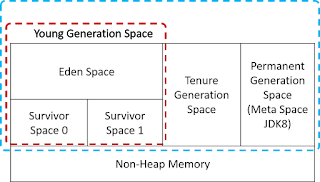
Java Heap Memory The Young Generation is where all new objects are allocated and aged. Tenure Generation stores old objects, which initially in young generation space, aged and moved to. Permanent Generation Space stores metadata required by JVM to describe classes and methods used in the application. JVM Garbage Collection  Minor garbage collection  (quick, stop-the-world) All objects started at young generation space, Eden space. When Eden space is full, GC runs in Eden Space, selecting all survivor objects and move them to Survivor Space 0. When Eden space full again, GC runs in Eden Space and Survivor Space 0, selecting survivor and move them to Survivor Space 1. When Eden space full again, GC runs in Eden Space and Survivor Space 1, selecting survivor and move them to Survivor Space 0.So and so. Every time an object moved from one survivor space to another survivor space, they age. When their age reach 8 (JVM 8), they are moved to Tenure Generat...